
A complete document checklist for your EU visa application is the single most reliable way to avoid rejection before a consulate officer reads a single word of your cover letter. Most Schengen visa refusals trace back to missing paperwork, mismatched dates, or insurance that falls short of the required threshold. This guide gives you the full picture: every core document you need, how to organize them into a convincing package, what changes by country or situation, and the mistakes that trip up even well-prepared applicants. Whether you are applying for the first time or returning after a previous trip, this checklist is built for 2026 requirements.
What documents are required for a standard Schengen visa application?
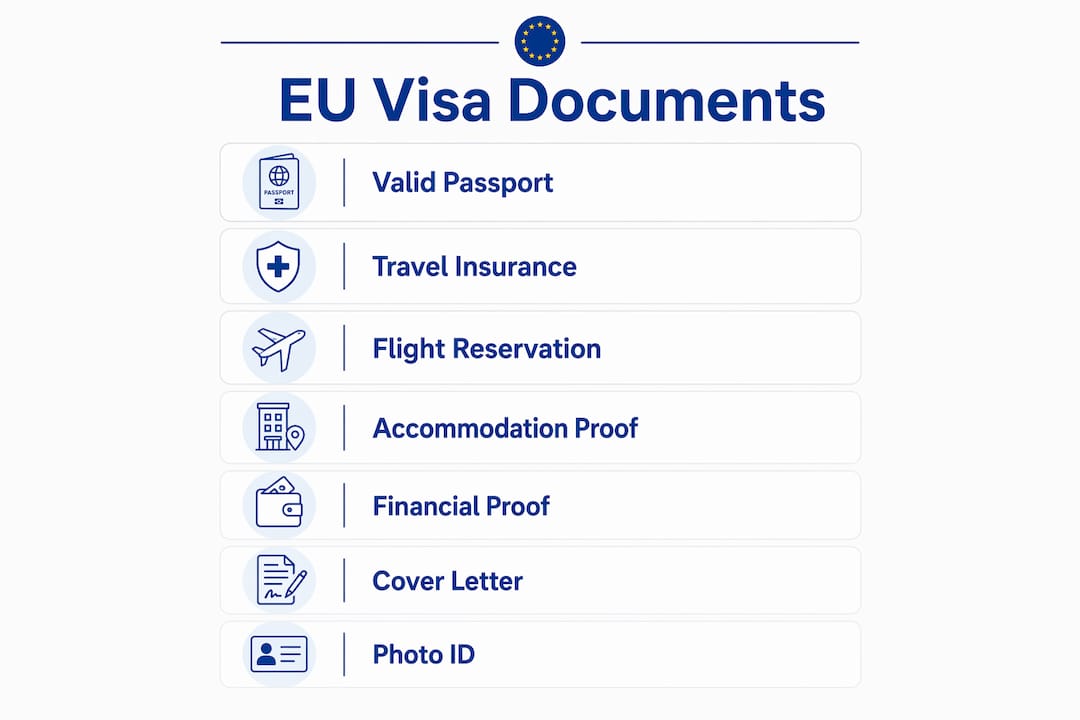
The Schengen visa application document checklist covers seven core categories. Every applicant, regardless of nationality or destination country, must submit all of them. Missing even one can trigger a delay or outright refusal.
-
Visa application form. The form must be completed in full, printed, and signed by hand. Any blank field or missing signature gives the consulate grounds to reject the application without review. Download the form directly from the consulate website of your destination country.
-
Passport. Your passport must be issued within 10 years, valid for at least three months beyond your planned departure date, and contain a minimum of two blank visa pages. A worn or damaged passport can also be rejected, so inspect the binding and photo page carefully.
-
Passport photos. Two recent photos taken within the last six months, sized 35mm x 45mm, against a plain white or off-white background. The photos must follow ICAO biometric standards: no glasses, neutral expression, and full face visible. Many applicants use photo booths at post offices or pharmacies that are calibrated to these specs.
-
Travel medical insurance. Your policy must provide minimum coverage of €30,000, cover emergency medical care and repatriation, carry zero deductible, and remain valid across the entire Schengen Area for the full duration of your trip. A policy that covers only your destination country will not pass. For country-specific insurance rules, Euinfohub’s guide on German health insurance breaks down compliance in plain terms.
-
Flight reservation or itinerary. You do not need to purchase a ticket before your visa is approved. A confirmed flight reservation showing your entry and exit dates is sufficient. The dates on this reservation must match your accommodation bookings and insurance coverage exactly.
-
Proof of accommodation. Hotel bookings, a signed rental agreement, or an official invitation letter from a host in the Schengen Area all qualify. If you are staying with a friend or family member, many consulates require a formal host declaration alongside a copy of the host’s ID or residence permit.
-
Proof of financial means. Bank statements covering the last three to six months, recent salary slips, or a sponsorship letter with supporting financial documents. The statements must show consistent, stable balances. A sudden large deposit just before the application date raises red flags.
-
Cover letter. This document ties everything together. It should explain the purpose of your trip, your planned itinerary, your ties to your home country, and how you will fund the trip. Think of it as the narrative that connects every other document in the package.
Pro Tip: Print a personal checklist page with your full name and passport number, then place it on top of your application stack. A labeled checklist page reduces the risk of missing documents and signals to the officer that your application is organized and complete.
How to organize your documents for a stronger application

The way you present your documents matters almost as much as the documents themselves. Visa officers review applications as a coherent story, and consistent documents significantly increase approval chances. A disorganized stack of papers forces the officer to do extra work, and that extra work rarely benefits the applicant.
Follow this sequence when assembling your package:
- Place the checklist page first. Include your name, passport number, and a tick next to each enclosed document.
- Application form and photos. These go directly after the checklist, since they are the officer’s first point of reference.
- Passport and copies. Include the original passport plus photocopies of the bio-data page and any previous Schengen visas.
- Insurance certificate. Attach the full policy document, not just a summary card.
- Flight reservation and accommodation proof. Group these together since the dates must match.
- Financial documents. Bank statements, salary slips, and any sponsorship letters in one section.
- Cover letter and supporting ties. Employment letter, enrollment certificate, property documents, or any other proof of return ties to your home country.
Pro Tip: Before sealing the envelope or handing over the folder, cross-check every date across your itinerary, insurance, and accommodation bookings. Date mismatches trigger manual review and are one of the most common causes of application delays.
If any document is in a language other than the consulate’s official language or English, you need a certified translation. Use a sworn translator recognized in the destination country, not a generic online service. Some consulates maintain a list of approved translators on their websites.
| Document type | Key consistency check |
|---|---|
| Flight reservation | Entry and exit dates match insurance and accommodation |
| Insurance certificate | Coverage dates span full trip, minimum €30,000 |
| Bank statements | No sudden large deposits; covers at least 3 months |
| Accommodation proof | Dates align with flight reservation |
| Cover letter | Mentions all enclosed documents and explains purpose |
For digital submissions, scan every document at 300 DPI minimum and save files in PDF format. Label each file clearly, for example “BankStatement_LastName_2026.pdf,” so the reviewing officer can locate documents without confusion.
What additional documents vary by country or applicant situation?
The EU baseline checklist is your starting point, but country-specific consulate requirements add layers of documentation that many applicants miss entirely. This is where generic checklists fail you.
Here are the most common situation-specific additions:
-
Germany. Hosts sponsoring a visitor may need to submit a Verpflichtungserklärung, a formal financial guarantee declaration issued by the local Ausländerbehörde. Without it, a family visit application to Germany is often incomplete. Euinfohub’s Germany visa checklist walks through this process step by step.
-
Business visa applicants. Add an invitation letter from the host company on official letterhead, your company’s registration documents, and a letter from your employer confirming your position, salary, and the business purpose of the trip.
-
Family visit applicants. Proof of relationship is required, such as birth certificates or marriage certificates, alongside the host’s proof of legal residence in the Schengen Area.
-
Minors traveling alone or with one parent. A notarized consent letter from the absent parent or legal guardian is mandatory at most consulates. Some also require a copy of the child’s birth certificate and the consenting parent’s ID.
-
Biometric data. Most first-time applicants must appear in person to submit fingerprints. However, applicants with a prior Schengen visa issued within the last 59 months may not need to provide new biometric data, which can reduce the number of in-person appointments required.
-
Non-residents or third-country nationals. If you are applying from a country that is not your country of citizenship, you must also provide proof of legal residence in the country where you are applying, such as a valid residence permit.
Always verify the exact requirements on the official consulate website of your destination country. For Italy-specific requirements, Euinfohub’s Italy visa checklist provides a detailed breakdown that goes beyond the standard Schengen list.
Common mistakes that lead to EU visa refusals
Incomplete documentation, insufficient insurance, and unclear intention to depart are the three most cited reasons for Schengen visa refusals. Each one is preventable with a careful pre-submission review.
Watch out for these specific errors:
- Unsigned or incomplete application form. A single blank field or missing signature is grounds for rejection without further review.
- Insurance that does not meet the threshold. Policies with co-payments, coverage gaps, or limits below €30,000 fail the requirement. Always read the policy document, not just the summary.
- Mismatched dates. Your flight reservation, insurance, and accommodation must cover the same date range. Even a one-day gap raises a flag.
- Vague accommodation proof. A screenshot of a hotel search result is not proof of booking. Submit a confirmed reservation with your name, dates, and booking reference.
- Last-minute financial spikes. Depositing a large sum into your account the week before submission looks suspicious. Consulates want to see stable, consistent balances over several months.
- No proof of return ties. Consulates prioritize applicants who demonstrate strong reasons to return home, such as employment letters, enrollment certificates, or property ownership documents.
- Ignoring consulate-specific instructions. Each embassy may have its own formatting or ordering requirements. Read the submission guidelines on the official website before you print a single page.
“Relying on a generic checklist without verifying embassy-specific requirements is one of the most frequent causes of rejection that applicants could have avoided with 20 minutes of research.”
For a deeper look at application errors, Euinfohub’s article on visa application mistakes covers the most damaging ones with practical fixes.
Pro Tip: Submit your application up to 6 months before travel. Standard processing takes 10 to 15 days, but complex cases or peak seasons can extend that significantly. Early submission gives you time to respond to any requests for additional documents.
Key takeaways
A successful EU visa application depends on submitting a complete, consistent, and well-organized document package that meets both the Schengen baseline and your specific consulate’s requirements.
| Point | Details |
|---|---|
| Core documents are non-negotiable | Every applicant needs a valid passport, insurance, financial proof, itinerary, and accommodation confirmation. |
| Insurance must meet the threshold | Coverage must be at least €30,000 with zero deductible and valid across the full Schengen Area. |
| Consistency is critical | Dates across your flight reservation, insurance, and accommodation must match exactly. |
| Country-specific extras apply | Germany, Italy, and other destinations require additional forms or declarations beyond the EU baseline. |
| Submit early | Apply up to 6 months before travel to allow time for processing and any document corrections. |
What I have learned from watching applicants get this wrong
I have reviewed a lot of visa applications over the years, and the pattern is almost always the same. The applicants who get rejected are not the ones who lacked the money or the legitimate purpose. They are the ones who treated the application as a form-filling exercise rather than a storytelling exercise.
The consulate officer reviewing your file has about 10 minutes with your documents. In that time, they need to answer one question: does this application make sense? If your flight leaves on March 15 but your insurance starts on March 16, the story breaks. If your bank statement shows a €5,000 deposit three days before submission, the story breaks. If your cover letter does not mention why you are visiting or when you plan to return, the story breaks.
My honest advice is to start collecting documents at least two months before your planned submission date, and six months before your travel date if you want real breathing room. Do not rely on a single generic checklist. Pull up the official consulate website of your destination country and compare it line by line against what you have prepared. If anything is in a foreign language, get it certified. If your financial history is thin, add a sponsorship letter with supporting documents from the sponsor.
The cover letter is the most underused tool in the entire application. Most people write three sentences. Write three paragraphs. Explain your itinerary, your ties to home, your funding source, and your reason for the trip. Give the officer a reason to approve you, not just a stack of papers to process.
— Muhammad
How Euinfohub can help you get this right
Getting your visa application right the first time saves you time, money, and stress. Euinfohub publishes detailed, up-to-date guides built specifically for international students and migrants preparing for EU visa submissions.
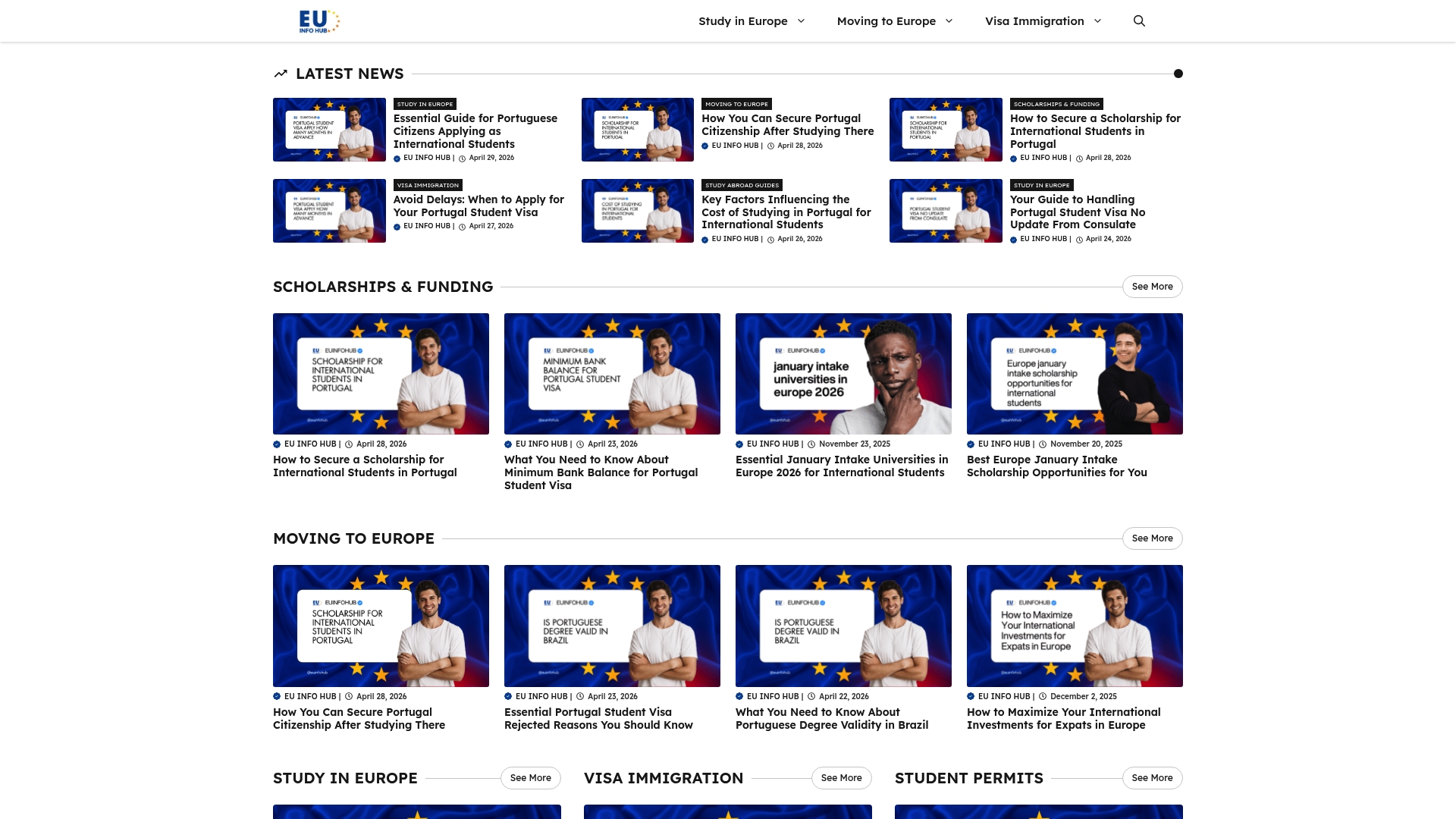
From country-specific document checklists to step-by-step breakdowns of passport and residency requirements, Euinfohub covers the details that generic resources skip. If you are working through your EU immigration visa process for the first time, the site’s structured guides walk you through each stage without the confusion. For applicants focused on long-term goals, the resource on European passport requirements provides a clear path from visa approval to residency and beyond. Start with the guide that matches your situation and build from there.
FAQ
What is the minimum insurance coverage for a Schengen visa?
Travel medical insurance must provide a minimum of €30,000 in coverage, including emergency medical care and repatriation, with zero deductible and validity across the entire Schengen Area for the full duration of your stay.
How far in advance should I apply for a Schengen visa?
You should submit your application up to 6 months before your travel date. Standard processing takes 10 to 15 days, but applying early gives you time to address any requests for additional documents.
Do I need to buy a flight ticket before applying?
No. A confirmed flight reservation showing your entry and exit dates is sufficient. You do not need to purchase the ticket until after your visa is approved.
What happens if my documents have mismatched dates?
Mismatched dates across your flight reservation, insurance, and accommodation bookings trigger manual review and are a leading cause of application delays and refusals. Cross-check all dates before submission.
Can I skip the biometric appointment if I have a previous Schengen visa?
Possibly. Applicants who had a Schengen visa issued within the last 59 months may not need to provide new biometric data, which can reduce or eliminate the need for an in-person appointment at the consulate.