
The EU visa waiver programme is a system that permits nationals of designated countries to enter the Schengen Area and select associated countries for short stays without applying for a traditional visa. The Schengen Area covers 29 countries, allowing eligible travelers up to 90 days of visa-free access within any 180-day period. Starting in late 2026, all visa-exempt travelers will also need to obtain ETIAS, a mandatory electronic travel authorization that works alongside the visa waiver but does not replace it. Whether you are planning a trip for tourism, business, or short-term study, understanding how this system works will save you time and prevent costly mistakes at the border.
What is the EU visa waiver programme and who qualifies?
The EU visa waiver programme grants nationals of so-called “Annex II” countries the right to enter the Schengen Area without a visa for short stays. These are countries whose citizens the EU has determined pose a low migration or security risk, based on factors like diplomatic agreements and historical travel patterns. The list includes citizens from the United States, Canada, Australia, Japan, South Korea, the United Kingdom, Brazil, and dozens more. Cyprus, while not part of the Schengen Area, also honors many of the same visa exemptions for short-stay travelers.
To qualify for visa-free entry, you must meet several conditions:
- Valid biometric passport: Your passport must contain an electronic chip. Standard non-biometric passports do not qualify.
- Permissible travel purpose: Tourism, business meetings, and short-term unpaid study are allowed. Working for pay is not.
- Stay within the 90/180 rule: You cannot spend more than 90 days in the Schengen Area within any rolling 180-day window.
- Sufficient funds and onward travel: Border officers can ask for proof that you can support yourself and that you plan to leave.
- No prior entry bans: If you have been deported or banned from the Schengen Area, the visa waiver does not override that restriction.
Some nationalities that generally qualify may still face restrictions based on travel history to specific countries. The EU updates its Annex II list periodically, so checking the official EU immigration portal before you travel is the safest approach.
Pro Tip: Always verify your country’s current status on the official European Commission website rather than third-party travel blogs, which may not reflect recent policy changes. Scam sites sometimes charge fees to “confirm” your visa waiver eligibility, which is always free to check officially.
How does ETIAS change travel for visa-exempt visitors?
ETIAS, the European Travel Information and Authorization System, is a mandatory pre-travel authorization launching in late 2026 for all visa-exempt nationals entering the Schengen Area. It is not a visa. Think of it as a background check you complete online before you fly, similar to the U.S. ESTA system. Once approved, your ETIAS authorization is valid for up to three years or until your passport expires, whichever comes first.
Here is how the ETIAS application process works:
- Complete the online form. You will provide personal details, passport information, travel history, and answer security questions. The form is available only through official EU platforms.
- Pay the authorization fee. The fee structure is set by the European Commission. Most adult applicants pay a small processing fee; travelers under 18 and over 70 are exempt.
- Wait for approval. Most applications receive a decision within minutes. Complex cases can take up to 30 days, so apply well before your travel date.
- Receive your authorization. Approval is linked electronically to your passport. You do not receive a stamp or sticker.
- Present your passport at the border. Border officers verify your ETIAS status automatically when scanning your passport.
ETIAS applies only to nationals from visa-exempt countries. If your nationality requires a Schengen visa, ETIAS does not apply to you at all. This distinction trips up many travelers who assume ETIAS is a universal requirement.
Pro Tip: Apply for ETIAS at least two weeks before departure to account for any delays. Have your passport, email address, and a credit or debit card ready before you start the form. Only use the official EU ETIAS application portal. Unofficial sites charge inflated fees and offer no added service.

EU visa waiver vs. Schengen visa vs. U.S. Visa Waiver Program
These three systems are frequently confused, and the differences matter significantly for your travel planning. The EU visa waiver (with ETIAS from late 2026) applies to Annex II nationals entering the Schengen Area for short stays. The Schengen visa (Type C) applies to nationals of countries not on the Annex II list who need formal permission to enter. The U.S. Visa Waiver Program allows citizens of 42 countries to travel to the United States for up to 90 days with an approved ESTA authorization.
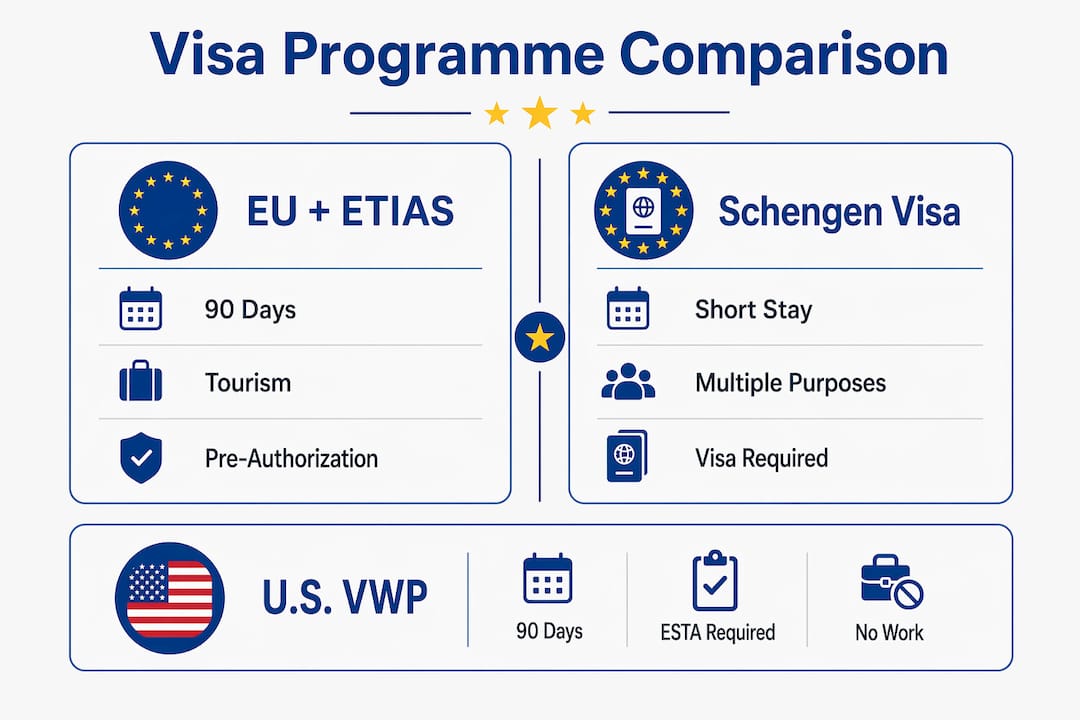
| Feature | EU visa waiver + ETIAS | Schengen visa (Type C) | U.S. Visa Waiver Program |
|---|---|---|---|
| Who it applies to | Annex II nationals | Non-exempt nationals | Citizens of 42 designated countries |
| Application required | ETIAS online form (from late 2026) | Full visa application at consulate | ESTA online form |
| Maximum stay | 90 days in any 180-day period | Up to 90 days per entry | 90 days per visit |
| Cost | Small ETIAS fee | €90 for adults | Small ESTA fee |
| Work permitted | No | No (Type C) | No |
| Processing time | Minutes to 30 days | 15 days to 8 weeks in advance | Usually within 72 hours |
One legal nuance that most travelers overlook: entering under a visa waiver typically means you waive your right to contest removal at the border, except in asylum cases. This applies to the U.S. program and has parallels in EU entry rules. You are not entitled to the same procedural protections as a visa holder if a border officer decides to deny you entry.
Visa waiver travel is strictly for tourism, business, and short-term unpaid activities. If you plan to work, enroll in a degree program, or stay longer than 90 days, you need the appropriate national visa or EU long-stay permit. No visa waiver or ETIAS authorization changes that requirement.
Pro Tip: If you hold dual nationality and one of your passports is from a Schengen member state, always enter on your EU passport. You have full freedom of movement rights that way, and the 90-day rule does not apply to you.
How to stay compliant when traveling under the EU visa waiver
Compliance under the EU visa waiver programme comes down to four practical areas: tracking your days, carrying the right documents, understanding what you can and cannot do, and knowing what happens if things go wrong.
- Track your 90-day allowance carefully. The 90/180 rule is a rolling window, not a calendar reset. If you spent 60 days in the Schengen Area in the past 120 days, you only have 30 days remaining. The Entry/Exit System (EES), which launched in April 2026, automates this tracking at borders, but you remain personally responsible for compliance.
- Carry your ETIAS authorization and biometric passport. From late 2026, arriving without a valid ETIAS means you can be denied boarding by airlines or turned away at the border.
- Know what you can and cannot do. Tourism, attending conferences, visiting family, and short unpaid internships generally fall within permitted activities. Taking paid employment, enrolling in a full degree program, or conducting activities that require a professional license do not.
- Understand the consequences of overstaying. Overstaying can result in fines, deportation, and a multi-year ban from the Schengen Area. The EES now creates an automatic digital record of every entry and exit, making it far harder to overstay undetected.
- Plan longer stays through proper channels. If you want to study in Europe for more than 90 days, you need a student visa. Euinfohub’s guide on student visa options breaks down the easiest EU countries to apply through in 2026.
Some travelers are surprised to learn that bilateral visa waiver agreements between individual EU member states and specific countries can allow stays beyond 90 days in certain circumstances. These agreements are exceptions, not the rule, and they require notifying border authorities in advance.
Pro Tip: Keep a simple spreadsheet or use a Schengen calculator app to log every entry and exit date. If you are ever questioned at a border, having a clear record of your travel history demonstrates good faith and speeds up the process considerably.
Key takeaways
The EU visa waiver programme allows Annex II nationals to enter the Schengen Area visa-free for up to 90 days, but ETIAS authorization becomes mandatory from late 2026 and must be obtained before travel.
| Point | Details |
|---|---|
| Visa waiver eligibility | Annex II nationals can enter the Schengen Area visa-free for up to 90 days in any 180-day period. |
| ETIAS is not a visa | ETIAS is a pre-travel authorization launching late 2026, valid for three years, required for all visa-exempt travelers. |
| Work and study limits | Visa waiver travel permits tourism and business only. Work or long-term study requires a separate national or EU visa. |
| Overstay consequences | The EES system launched in April 2026 automates entry tracking, making overstays detectable and subject to fines or bans. |
| Use official channels only | Apply for ETIAS only through the official EU platform to avoid fraud and unnecessary fees. |
Why ETIAS is a bigger shift than most travelers realize
I have spent years watching travelers treat visa policy as a static checklist, and ETIAS is the clearest example of why that approach will get you into trouble. Most people I speak with still think of the EU visa waiver as a simple “no paperwork needed” arrangement. That changes in late 2026, and the adjustment period will catch a lot of people off guard.
What strikes me most about ETIAS is not the authorization itself. It is the data infrastructure behind it. The combination of ETIAS and the Entry/Exit System creates a real-time, cross-border picture of every visa-exempt traveler in the Schengen Area. For legitimate short-term travelers, this is actually good news. It reduces the discretionary power of individual border officers and creates a more predictable entry experience.
The risk I see is the flood of unofficial ETIAS websites already appearing online. Official EU guidance is clear that the only legitimate application channel is the official EU portal. But travelers in a hurry, or those unfamiliar with EU bureaucracy, will pay inflated fees to third-party sites and sometimes receive nothing in return.
My honest advice: treat ETIAS the way you treat your passport renewal. Do it early, do it through the right channel, and do not wait until a week before your flight. The EU visa waiver programme still offers remarkable freedom of movement for eligible nationals. Respecting the rules that come with it is what keeps that freedom intact.
— Muhammad
Plan your EU travel with confidence using Euinfohub
Euinfohub is built for exactly this moment in your planning process. Whether you are traveling short-term under the EU visa waiver or considering a longer stay for study or work, the site gives you clear, up-to-date guidance on every step.

If your plans go beyond 90 days, Euinfohub’s student visa processing guide walks you through every document and deadline you need. For those thinking further ahead, the guide on European passport requirements covers the full pathway from short-term travel to long-term residency and citizenship. You can also explore the step-by-step study abroad guide for a complete picture of what studying in the EU actually involves. Start with the right information and you will avoid the mistakes that slow most applicants down.
FAQ
What is the EU visa waiver programme?
The EU visa waiver programme allows nationals of designated “Annex II” countries to enter the Schengen Area for up to 90 days in any 180-day period without applying for a traditional visa. It covers tourism, business, and short-term unpaid activities.
Do I still need ETIAS if my country has a visa waiver?
Yes. Starting in late 2026, all visa-exempt nationals must obtain ETIAS authorization before traveling to the Schengen Area. ETIAS is not a visa but a mandatory pre-travel check linked to your passport.
Can I work or study in the EU under the visa waiver?
No. The visa waiver permits only tourism, business visits, and short-term unpaid activities. Paid employment or enrollment in a degree program requires a national work or student visa from the relevant EU country.
How do I avoid overstaying under the EU visa waiver?
Track your entries and exits carefully using the 90/180 rolling window rule. The Entry/Exit System launched in April 2026 now records every border crossing automatically, so overstays are flagged and can result in fines, deportation, or a Schengen ban.
Is the EU visa waiver the same as the U.S. Visa Waiver Program?
No. The U.S. Visa Waiver Program covers citizens of 42 countries traveling to the United States with ESTA approval, while the EU system covers Annex II nationals entering the Schengen Area. Both allow 90-day stays and prohibit work, but they are separate legal systems with different country lists and application processes.