

Heading off to Lithuania for your studies is exciting, but you can’t skip the Lithuania student visa application checklist 2026 if you’re a non-EU citizen. Your visa D grants you legal entry and lets you stay longer than three months. Without it, enrolling in classes, opening a bank account, or even renting a flat becomes a headache. So, have you gone through the Lithuania student visa application checklist? Fret not if you haven’t. This guide walks you through every step, so you’ll know exactly which papers to gather, how to book appointments, and what to expect at each stage. Ready to get started? Let’s dive in.
Who Needs Visa D?
Before you fill in any forms, check if you actually need a student visa. You’ll probably need a visa D if you’re a:
- Non-EU or non-EEA citizens registering for programs longer than three months
- Exchange students from countries without visa-free access for extended stays
- Those planning to work part-time (up to 20 hours per week) during studies
If you hold EU, EEA, or Swiss citizenship and your course is under 90 days, you’re visa-exempt. For programs beyond three months, you’ll still need a residency certificate from the Ministry of the Interior.
How Visa and Residence Permit Work In Lithuania?
If you plan to study in Lithuania, it’s important to understand that your student stay is usually divided into two stages: the National Visa (D) and the Temporary Residence Permit (TRP).
The National Visa (D) is issued before you travel and allows you to enter Lithuania legally. It is usually valid for up to one year and is often used as a bridge until your TRP is approved.
The Temporary Residence Permit, on the other hand, is what allows you to stay in Lithuania for the whole duration of your studies. Once you receive your TRP, it effectively replaces the National Visa and becomes your main legal document for living in Lithuania.
Both applications can be started online through the MIGRIS portal, but the process may vary depending on your country. In many cases, you’ll first apply for the National Visa (D) to ensure you can enter Lithuania on time, and then submit your TRP application either before or after arrival. Since the TRP can take several months to process, having the National Visa is essential to avoid gaps in your legal stay.
Now that you understand the difference between a visa and a student permit, let’s review the checklist you need to complete before applying for admission.
Things to Know Before You Apply for a Student Visa Application
A bit of prep goes a long way. Here’s how to line up everything smoothly.
Check Program Requirements
Each university has its own enrollment conditions. Therefore, you need to confirm:
- Official acceptance or confirmation letter
- Proof of payment for tuition deposit (if required)
- Registration in the national student database
Without these, your visa application won’t pass the first filter.
Plan Around Processing Times
Consulates aim to decide within 15 days, but individual cases can stretch to 45 days (Studee). Add another week or two for mailing and MIGRIS scheduling. As a rule of thumb:
- Apply at least 8–10 weeks before your course starts
- Factor in busy season spikes around September
Lithuania Student Visa Application Checklist 2026
Here’s your go-to list of what to include. Ticking off each item cuts delays and keeps stress low.
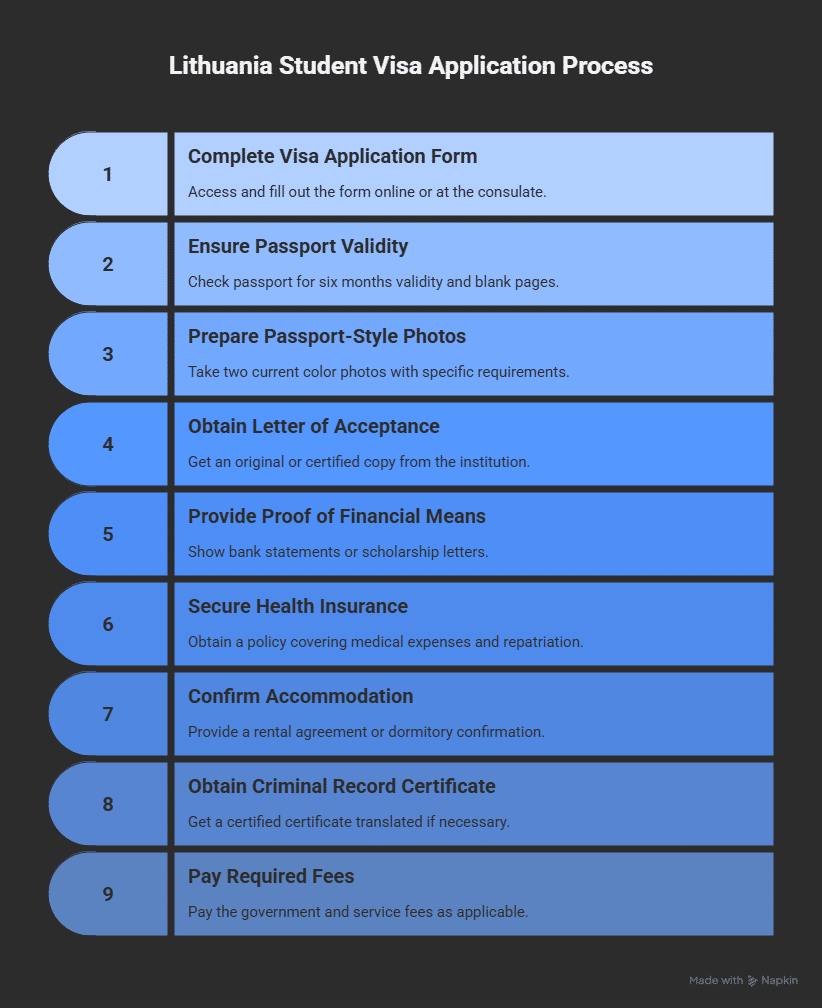 Are you covered on all fronts? Double-check this list before hitting submit.
Document Details and Tips
Getting the right format and translations saves you headaches down the line.
Translations and legalizations
All non-English or non-Lithuanian documents need certified translations. Remember:
- Use a sworn translator
- Legalize or apostille country-of-origin certificates
- Submit originals plus one copy each
Photo requirements
Photos trip up more applications than you might think:
- Head straight on – no side profiles
- Neutral expression, mouth closed
- Remove hats or headgear unless for religious reasons
Financial proof nuances
Showing pocket money for each month reassures the consulate. You can combine:
- Personal bank statements
- Letter of financial support from parents/sponsors
- Scholarship award letters with official stamps
How to Submit Your Application For Admission?
Once your docs are ready, you are all ready to submit them for admission.
Applying online via MIGRIS
The Lithuanian Migration Information System (MIGRIS) is your starting point:
- Register an account at MIGRIS.
- Fill in personal details and upload digital copies.
- Pay the government fee online.
- Schedule an appointment at your local Migration Department office.
Booking an appointment
After MIGRIS, you’ll get a confirmation letter. Then:
- Show up on time with originals
- Bring printed copies of digital uploads
- Expect a brief interview on your study plans
Using VFS Global
In some countries, VFS Global handles intake. In that case:
- Book at the VFS portal in your region
- Drop off documents at the visa centre
- Track service status online
Processing Times and Tracking
You submitted, now you wait. Here’s what to expect:
| Stage | Typical time | Extensions allowed |
|---|---|---|
| Initial decision | 15 days | Up to 45 days |
| Document verification | 3–7 days | Varies by region |
| Permit issuance | 5–10 business days | Depends on caseload |
You can check your MIGRIS dashboard or VFS portal regularly. If you haven’t heard back after 45 days, consider contacting the Migration Department.
After You Receive Your Visa
Congrats, you’ve got your sticker! Here’s what comes next.
Entry and TRP collection
On arrival:
- Enter Lithuania within the visa validity
- Visit the Migration Department office you chose
- Submit originals, get your biometric permit card
Your TRP replaces visa D and stays valid for the academic year. Renew online if your program extends beyond initial dates.
Registering your residence
Within 7 days of settling in, register your address at the local municipality office (savivaldybė). This lets you:
- Open a bank account
- Sign up for local health services
- Get a student transport discount card
Common Mistakes to Avoid
Even small slip-ups can delay your application. Watch out for:
- Missing signatures on application forms
- Insurance policies with insufficient coverage
- Bank statements older than one month
- Translations without proper certification
- Scheduling appointments too close to your departure
For more on pitfalls and how to dodge them, check our common mistakes on student visa applications.
Related resources and checklists
Need other European student visa guides? Explore:
- Step-by-step guide for a student permit
- Student permits
- France student visa application checklist 2026
- Germany student visa application checklist 2026
Or browse our full student visa application checklist hub for every EU country.
Key takeaways
- Check eligibility early and line up your acceptance documents
- Use the MIGRIS system to apply online and book your appointment
- Gather certified translations, photos, insurance, and proof of funds
- Track processing times and register your residence after arrival
- Avoid common slip-ups by double-checking every file
With this Lithuania student visa application checklist 2026 in hand, you’re all set to focus on what really matters.