
France has no separate retirement visa. If you want to live there on pensions, savings or (with caveats, see below) remote income for a US employer, the France long stay visa for Americans to use is the VLS-TS visiteur. You apply on France-Visas before you leave the US, then validate the visa online within 3 months of arriving.
After the first year, you renew it as a carte de séjour visiteur. The legal income test is the French net minimum wage (about €1,477.93 a month since 1 June 2026). You cannot work for French clients. Below you will find a worked income check for a retired couple, a dated timeline, and the renewal rules.
Key facts at a glance
| Question | Short answer (as of October 2026) |
|---|---|
| Which visa? | Long-stay (type D) visa VLS-TS "visiteur", for stays over 90 days without working in France |
| Who decides? | The French Consulate General in Washington, D.C., for all US applications |
| Where to apply in person | TLScontact, at any of its 10 US centres |
| Legal income test | Annual net SMIC: about €1,477.93 a month, or about €17,735 a year, for one person (couples: plan to show this for each spouse) |
| Safer planning target | Gross SMIC: €1,867.02 a month since 1 June 2026 |
| When to apply | No earlier than 3 months before departure. France-Visas recommends an appointment at least 1 month before you leave (aim for 6 to 8 weeks). |
| Visa fee | Commonly €99, plus a visa centre service fee of roughly €30 to €45 |
| Validation tax | About €300 (visiteur, since May 2026), confirm on ANEF |
| Card renewal (year 2) | About €250 |
| After arrival | Validate online on ANEF within 3 months |
| Public health cover | PUMa after about 3 months of stable residence |
| Renewal window | 4 to 2 months before your visa or card expires, online |
| French language | Not required for the visa or the annual card |
Budget for official fees per person: visa €99 + centre fee about €30 to €45 + validation about €300 = roughly €429 to €444 in year 1, plus private health insurance for the whole stay. Add about €250 for the card renewal in year 2.
How much income do you need for the France visitor visa in 2026?
The law asks for resources at least equal to the annual net SMIC (the French minimum wage), under CESEDA article L426-20. Since 1 June 2026, one legal guide puts this at €1,477.93 net a month for one person, or about €17,735 a year, and says welfare benefits do not count (Justifit).
The SMIC rose 2.41% on 1 June 2026, to €12.31 gross an hour. For a 35-hour week, that is €1,867.02 gross a month, up from €1,823.03 since 1 January 2026 (info.gouv.fr, Urssaf). The net figure of about €1,477.93 is an estimate for a standard employee (Compta-Online).
Many websites quote other numbers (€1,200, €1,500, "about $2,000"), and some say consulates judge each file case by case. The justice.fr page still shows an older figure of €1,443.11 net a month. Planning around the gross SMIC puts you above every figure commonly quoted, though the consulate still looks at your whole file.
| Benchmark | Per month, 1 person | Per year, 1 person | Status |
|---|---|---|---|
| Net SMIC (legal test) | €1,477.93 | About €17,735 | What the law refers to |
| Gross SMIC | €1,867.02 | €22,404.24 | Conservative planning target |
| Older justice.fr figure | €1,443.11 | €17,317.39 | Out of date since June 2026 |
What counts as proof of resources?
You can use bank statements, guarantees from solvent people, or proof of income. Retirees can use a pension statement (justice.fr). A Social Security benefit letter, IRA or 401(k) statements, and savings or brokerage statements can all go in your file.
Do both spouses need to meet the minimum?
Sources disagree. One law firm page says each family member must personally meet the visiteur conditions. Another says a spouse with no income can rely on the partner's resources if the file proves the relationship and shows the money really reaches the household (Kohen Avocats). The safe approach is to show enough for two people and include your marriage certificate.
Worked example: a US retiree couple
Mark (67) and Linda (64) want to retire near Bordeaux. At the exchange rate on the day they prepare their file, their combined Social Security comes to €2,700 a month. They plan IRA withdrawals of €1,000 a month. Total: €3,700 a month.
- Net test for two: €1,477.93 × 2 = €2,955.86. They pass, with €744.14 to spare.
- Gross target for two: €1,867.02 × 2 = €3,734.04. They fall €34.04 short.
- Yearly view: €3,700 × 12 = €44,400, against about €35,470 (€17,735 × 2) under the net test.
On paper they meet the legal test. But their income is in dollars, so a weaker dollar shrinks the euro amount. They add savings statements and their IRA balance to show a cushion. That turns a "just above" file into a comfortable one. Their official fees for two come to roughly €858 to €888 in year 1, before insurance.
What documents do US citizens need for the VLS-TS visiteur?
A US citizen staying more than 90 days must get a long-stay (type D) visa before leaving the US. The Consulate General in Washington, D.C. decides all US applications, and you apply on France-Visas (SKEMA). TLScontact runs 10 US centres (Atlanta, Boston, Chicago, Houston, Los Angeles, Miami, New York, San Francisco, Seattle and Washington, D.C.), and US residents can book at any of them (France-Visas). TLScontact replaced VFS Global as the US provider in April 2025, so ignore older guides that mention VFS.
The core file, according to a 2026 guide (Hilivsolution) and the official US page on France-Visas:
- A signed commitment not to work in France
- Private health insurance covering your whole stay
- Proof of accommodation in France
- Proof of resources (see above)
- A passport under 10 years old, with 2 blank pages, valid at least 3 months beyond the visa's expiry
One source says 15 months of passport validity, so follow the consulate's own checklist if it differs. Medicare does not cover care in France, so you need private or international insurance for the visa (BestCitiesInFrance).
Immigration and tax rules change and files are judged one at a time, so confirm your own case with France-Visas, the French consulate or a qualified adviser.
How to apply for a France long stay visa as an American: the timeline
The hardest part is timing. You cannot submit more than 3 months before your planned departure (Hilivsolution). Appointment lead times in busy US markets run about 4 to 8 weeks (Migaku). France-Visas recommends an appointment at least 1 month before departure and says processing usually takes about 15 days, but can run up to 45 days in some cases (France-Visas).
- Check your passport against the rules above. Renew it first if needed.
- Prepare documents early: insurance policy, lease or host letter, bank and pension statements, and the signed no-work commitment.
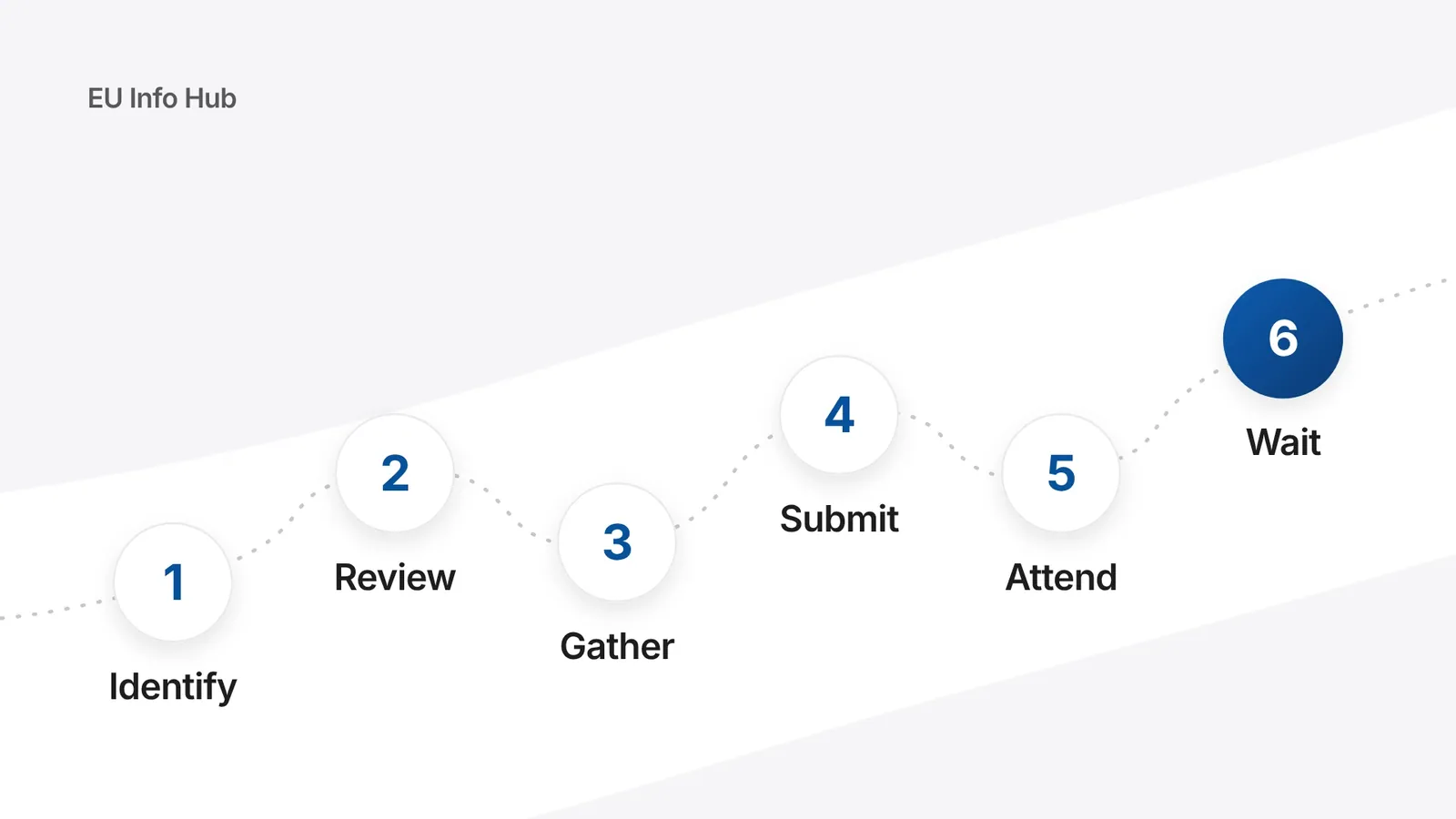
- Complete the France-Visas application no earlier than 3 months before departure. France-Visas recommends an appointment at least 1 month before you leave (aim for 6 to 8 weeks).
- Book your TLScontact appointment right away, at any of the 10 US centres. Pay the visa fee (commonly €99) plus the service fee of roughly €30 to €45. The visa fee is not refunded if you are refused (EasyFranceNow).
- Attend the appointment with originals and copies. The Washington consulate makes the decision.
- Fly to France once the visa is in your passport.
- Validate the visa on ANEF within 3 months of arrival. The visa works as a residence permit only once validated (Campus France). You pay a validation tax online, reported at €300 for visiteur since 1 May 2026 (it was €200 before) (Kohen Avocats). The exact amount appears on ANEF when you pay.
- Apply for PUMa through your local CPAM after about 3 months of residence. Keep private insurance until coverage is active.
- File your renewal online between 4 and 2 months before the visa expires.
Worked timeline with real dates
| Step | Date for a 1 April 2027 arrival |
|---|---|
| Earliest France-Visas submission | 1 January 2027 |
| Appointment, if booked 1 January (4 to 8 weeks lead time) | Late January to late February 2027 |
| Latest recommended appointment (1 month before travel) | 1 March 2027 |
| Decision (usually about 15 days, up to 45 days) | Mid-February to mid-April 2027 |
| Validate on ANEF | Before 1 July 2027 |
| Apply for PUMa | From about early July 2027 |
| Renewal window, if the visa ends 31 March 2028 | About 1 December 2027 to 31 January 2028 |
Look at the decision row. With a late appointment and a slow decision, your visa could arrive after your planned flight. Book a flexible ticket, or set your departure a few weeks later than you would like. Your actual expiry date is printed on the visa, so build your renewal dates from that.
Can I work remotely in France on a visitor visa?
On 23 June 2026, the Interior Ministry answered written question no. 11730 (Official Journal, page 5748). It said a non-EU national who works remotely for a foreign-law employer, and not for a business in France, is treated as "non-active" under French law. So remote work for a US employer is not, in itself, a banned professional activity on visitor status (Assemblée nationale, FNPR).
Read the limits carefully:
- It is a ministerial answer, not a new visa and not a change to the law.
- It covers residence law only. It does not settle French tax residence or social-security obligations (Kohen Avocats).
- It does not cover any activity for the French market, however small. Working for French clients remains off-limits.
- It speaks of employees of a foreign employer. Freelancing for US clients is not directly addressed, so get advice before relying on it.
- You still sign the no-work commitment, and a ministerial answer does not bind the consulate or prefecture. Be open about remote work in your file and keep proof that your employer, pay and clients are outside France.
If you plan to work remotely, our guide to remote work options in Europe for non-EU citizens compares other countries' rules.
Health insurance: Medicare, private cover and PUMa for American retirees
For the visa, you need private insurance covering the whole stay. Medicare will not pay for care in France.
Once in France, public cover (PUMa, through CPAM) opens after about 3 months of stable, regular residence. You keep it only if you genuinely live in France more than 6 months a year, and private insurance covers the first months (Kohen Avocats).
The official wait is 3 months, but one source says coverage is often active only 6 to 9 months after arrival because of processing delays. Budget for private insurance for most of your first year. PUMa may also carry an annual contribution for residents without French work income; check with Urssaf.
How to renew your carte de séjour visiteur
The visiteur card is valid for up to 1 year and is renewable (justice.fr). You file online. The window opens 4 months and closes 2 months before your visa or card expires. If the prefecture has not replied after 4 months, that counts as an implicit refusal.
Renewal is not automatic today. A law on automatic renewal of residence permits is reported to be awaiting Senate adoption, but it is not in force as of October 2026. Since 1 May 2026, renewing a card at the normal rate costs €250 (a €200 tax plus €50 stamp duty). Check the exact amount on ANEF when you pay.
How many months a year must you live in France?
No official page we found sets a minimum number of days for renewing a visiteur card. But renewal can be refused if you cannot show your habitual residence is in France (Kohen Avocats). PUMa also requires living in France more than 6 months a year. The practical rule: spend more than 6 months a year in France and keep proof (utility bills, lease, bank activity).
Do you need to speak French?
No, not for the visa or the annual card. Since 1 January 2026, a first multi-year card requires A2 French plus a civic exam, and a first 10-year resident card requires B1 plus a civic exam. People over 65 are exempt (service-public.gouv.fr). Renewing an annual visiteur card does not trigger these tests (French Connections).
Can the visiteur card lead to longer residence?
The visiteur card is renewed one year at a time with no set limit (FrenchEntrée). Sources differ on whether it can convert to a multi-year card, so plan on yearly renewals. After 5 years of legal residence you may be able to apply for a 10-year resident card, which needs B1 French and a civic exam unless you are over 65 (service-public.gouv.fr resident card).
Common mistakes
- Using the gross SMIC as the legal test. The law uses net. Gross is a cushion, not a requirement.
- Applying at the wrong time. You cannot apply more than 3 months before departure, and France-Visas recommends an appointment at least 1 month before you leave (aim for 6 to 8 weeks).
- Booking a fixed flight. Appointment and decision delays can push you past it.
- Looking for a VFS Global centre. TLScontact is the only US provider now.
- Forgetting ANEF validation. After 3 months without it, you are in France irregularly even though the sticker has not expired, you can be refused a card or ordered to leave, and you may need a new visa to come back if you leave.
- Dropping private insurance too soon. PUMa can take months to activate.
- Missing the renewal window. It closes 2 months before expiry. Filing late can mean a €180 regularisation fee (droit de visa de régularisation) on top of the normal card fee (CESEDA art. L436-5; waived for force majeure) (Kohen Avocats), and a gap in your rights while the file is processed.
- Spending too little time in France. You risk losing PUMa and failing the habitual residence test.
- Taking French clients while working remotely. The June 2026 answer does not cover any French-market work.
- Skipping the French tax return. A treaty credit does not remove the duty to file.
Comparing countries? The Portugal D7 visa for US citizens and our guide to retiring in Spain as an American cover similar passive-income routes. For short trips before you move, see ETIAS and EES rules for US citizens.
Frequently asked questions
Is there a retirement visa for France?
No. France has no separate retirement visa. American retirees use the long-stay visitor visa (VLS-TS visiteur), which lets you live in France for more than 3 months without working. You show enough resources, private health insurance and accommodation, and you sign a commitment not to work. After the first year, you renew it as an annual carte de séjour visiteur through the online ANEF system.
Does Social Security and IRA income count for the France visitor visa?
Yes. Accepted proof includes bank statements, proof of income and, for retirees, pension statements, so a Social Security benefit letter and IRA or 401(k) statements fit. Savings statements also count. The legal test is about €1,477.93 net a month per person since June 2026. Because your income is in dollars, show a margin above the threshold so a weaker exchange rate does not push you below it.
Will I owe French tax on Social Security and IRA withdrawals?
One 2026 guide says France generally gives a credit for US-taxed income (Optimavi). Under the treaty, US Social Security is taxed differently from private pensions and IRA or 401(k) withdrawals, so get advice specific to each income type. As a French tax resident, you must file a French return each year declaring worldwide income. You keep filing US returns, and FBAR/FATCA reporting applies to French accounts. Verify with a cross-border tax adviser.
What happens if I miss the 3-month validation deadline?
If you do not validate within 3 months, the visa stops working as a residence permit and you are in France irregularly, even though the visa sticker has not expired. You can be refused a residence card or ordered to leave. If you leave France after the deadline, you may need a new visa to return. A late validation is not guaranteed to work (Kohen Avocats). Validate in your first weeks.
Can I travel while on the visa?
Yes. A validated VLS-TS or visiteur card, together with your passport, lets you leave and re-enter France and visit other Schengen countries for short stays (up to 90 days in any 180). Validate before any trip that falls after your first 3 months. Long absences can weaken your habitual residence and PUMa rights at renewal. Confirm current travel rules with France-Visas before you book.
Can I renew the visitor card every year?
Yes. The visiteur card lasts up to 1 year and is renewable with no set limit. You file online between 4 and 2 months before expiry, and no reply after 4 months counts as a refusal. Each year you must again show resources, insurance and that France is your habitual residence. Renewal costs about €250 at the normal rate, is not automatic, and needs no French test.
References
- France-Visas: United States of America
- info.gouv.fr: Le SMIC revalorisé le 1er juin 2026
- Urssaf: Le Smic et le minimum garanti augmentent au 1er juin 2026
- justice.fr: Carte de séjour temporaire visiteur
- Assemblée nationale: Written question no. 11730 (remote work on visitor status)
- service-public.gouv.fr: Carte de séjour pluriannuelle
- service-public.gouv.fr: 10-year resident card
- Campus France: How to validate your long-stay visa upon arrival in France
- Justifit: Carte de séjour visiteur
- Compta-Online: SMIC horaire, montant mensuel brut et net
- FNPR: Visa visiteur et télétravail en France
- Kohen Avocats: Validation du VLS-TS, délai de trois mois et taxe 2026
- Kohen Avocats: Carte de séjour visiteur et télétravail
- Kohen Avocats: Retiring in France as an American
- Kohen Avocats: Visitor Residence Permit guide 2026
- SKEMA Business School: Do American citizens need a visa for France?
- Hilivsolution: Long-Stay Visitor Visa France 2026
- EasyFranceNow: TLScontact appointment for a French long-stay visa
- Migaku: France VLS-TS Visitor Visa 2026
- French Connections: French visa and residency language requirements
- FrenchEntrée: France's new language requirements FAQ
- BestCitiesInFrance: Americans Retiring in France 2026
- Optimavi: Retire in France 2026

Muhammad Sahil
Founder and editor of EU Info Hub. Digital marketer with over seven years of freelance experience, now studying economics and business in Europe. He has been through the residence permit process himself. This article is general information, not legal or financial advice. Always confirm details with the relevant consulate or authority.