
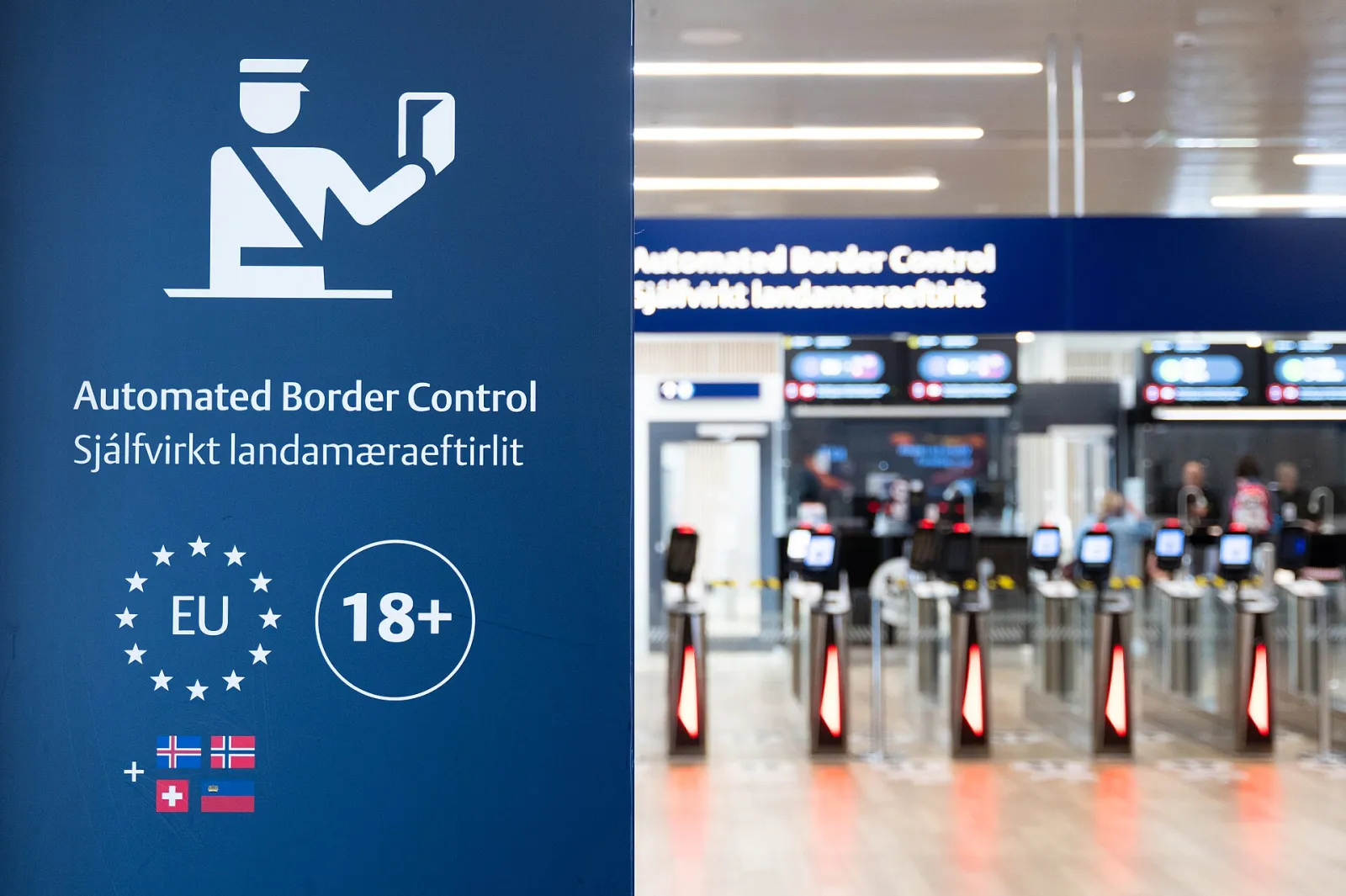
Do Americans need a visa for Europe? No, not for short trips. As of November 2026, US citizens can visit the Schengen Area for tourism or business for up to 90 days in any 180-day period without a visa, as long as their passport meets the validity rules.
The border has changed, though. The EU's Entry/Exit System (EES) now records your face and fingerprints instead of stamping your passport, and ETIAS, the planned travel authorization, is still not running. This guide explains the 90/180 rule, your passport and the new border check in plain terms.
Reviewed by the EU Info Hub editorial team. Last updated: 19 November 2026.
Key facts at a glance
| Question | Answer as of November 2026 |
|---|---|
| Visa for short trips | Not needed for tourism or business stays of 90 days or less |
| How long you can stay | 90 days in any rolling 180-day period, counted across all Schengen countries combined |
| Do entry and exit days count? | Yes, both count as full days |
| Passport validity | At least 3 months beyond the day you leave the Schengen Area, issued within the last 10 years (6 months recommended) |
| EES border check | Fully operational since 10 April 2026. Photo and fingerprints at the border, no application, no fee. Enforcement still varies at some crossings |
| ETIAS | Not in operation. No applications are being collected and no action is needed |
| Staying longer than 90 days | You need a long-stay national visa or residence permit from the country where you will live |
Do US citizens need a visa for Europe in 2026?
US citizens do not need a visa for a short trip to Europe's Schengen Area in 2026. A short trip means 90 days or less, for tourism or business.
The US State Department confirms that US citizens do not need a visa for tourism in Greece, a Schengen country, for stays of 90 days or less (U.S. Department of State). The same rule applies across the Schengen Area, because the 90-day limit covers the whole zone together.
Two new terms confuse many travelers. EES is a border record, not a visa or a pre-travel permit, and Americans remain visa-exempt (KAYAK). ETIAS is also not a visa. It is a pre-travel authorization similar to the US ESTA (French Ministry for Europe and Foreign Affairs).
One detail matters for mixed households: visa-free access depends on your citizenship, not on living in the US (Jetpac Global). Entry rules can change, so confirm your own case with the official site or a qualified adviser.
Visa, EES, ETIAS and long-stay visa compared
| Item | What it is | Do Americans need it now? | Cost |
|---|---|---|---|
| Schengen short-stay visa | A visa for stays up to 90 days | No, US citizens are visa-exempt | Not applicable |
| EES registration | Biometric record taken at the border when you enter and leave | Yes, at crossings of participating countries' external borders | Free, no application |
| ETIAS | Online pre-travel authorization, similar to ESTA | No, not in operation as of November 2026 | €20 for adults once it launches |
| Long-stay (D) visa or residence permit | National permission to live in one country | Only if you plan to stay longer than 90 days | Set by each country |
What do US citizens need to travel to Europe?
For a short trip, US citizens need a US passport book that meets the Schengen validity rules and a travel plan that fits inside the 90/180 limit. Expect to give a photo and fingerprints at the border under EES.
Here is the order to check things in, a few weeks before you fly:
- Look at the issue date and expiry date on your passport data page. You can run them through our passport validity checker to see if they work for your trip dates.
- Add up every day you have spent in Schengen in the last 180 days, plus the days you plan to spend. The easiest way is to check your dates with our Schengen 90/180 calculator.
- Note which countries on your route are outside the Schengen and EES system, such as Ireland and Cyprus, so you know which days count and where you may still get a stamp.
- Pack proof of your return or onward flight, where you are staying and how you will pay for the trip, in case a border officer asks.
- Ignore any website that asks you to pay for ETIAS now. There is nothing to apply for yet.
- Allow extra time at arrival, especially on your first entry, when officers take your biometrics for the first time.
- If you want to stay longer than 90 days, get a long-stay visa or residence permit from the country where you will live.
How long can Americans stay in Europe? The 90/180 rule explained
Americans can stay in the Schengen Area for a maximum of 90 days within any rolling 180-day period. The 90 days are counted across all Schengen countries combined, not per country (Iowa State University Global Programs).
So 30 days in France, 30 in Italy and 30 in Spain use up your full 90. You do not get a fresh 90 days when you cross into a new Schengen country.
The 180-day window is rolling, not a calendar half-year. On any given day, border authorities look back over the previous 180 days and count how many of those you spent in Schengen (Generali Global Assistance). That count must never go above 90.
EES does not change the 90/180 rule. It only automates the counting (KAYAK). Mistakes that might once have slipped past a busy officer with a stamp are now flagged by a computer.
Days in Ireland do not count, because Ireland is not in Schengen and the Schengen 90/180 clock does not run there (Onward Itinerary).
Which countries count toward your 90 days?
The European Commission says EES and the short-stay rules cover 29 European countries (European Commission). Those are Austria, Belgium, Bulgaria, Croatia, Czechia, Denmark, Estonia, Finland, France, Germany, Greece, Hungary, Iceland, Italy, Latvia, Liechtenstein, Lithuania, Luxembourg, Malta, the Netherlands, Norway, Poland, Portugal, Romania, Slovakia, Slovenia, Spain, Sweden and Switzerland.
Days in Ireland, Cyprus, the UK, Albania, Montenegro and Serbia do not use up your Schengen days. Each of those countries has its own entry rules, though. The UK, for example, requires Americans to get its own Electronic Travel Authorisation before traveling (GOV.UK), so apply before you add London to a Europe trip.
Worked example: two trips in one year
Say you are a retired couple from Ohio planning a long spring trip and a summer return in 2027. Under Schengen rules, the day you arrive and the day you leave both count as full days. The European Commission's official short-stay calculator counts them the same way.
- Trip 1: you arrive in Paris on 1 March 2027 and leave from Rome on 30 April 2027. That is 31 days in March plus 30 in April, so 61 days used.
- Trip 2: you want to come back on 1 July 2027. The 180-day window for 1 July runs from 3 January to 1 July, so all 61 days from Trip 1 still count.
- Days left: 90 minus 61 leaves 29 days. You can stay from 1 July to 29 July 2027. On 29 July your count is exactly 90.
- The trap: on 30 July the window runs from 1 February to 30 July. Trip 1 is still fully inside it, so staying that day would put you at 91 days, which is an overstay.
Your March days only start dropping out of the window on 28 August 2027, when the window begins on 2 March. The April days keep counting until late October: 30 April drops out on 27 October 2027.
Does the 180 days reset?
No. There is no reset date, not on January 1 and not 180 days after your first trip. Old days fall out one at a time as the window moves forward, which is why a calculator is safer than mental math.
Do you need 6 months of passport validity for Europe?
No. The State Department's Greece page, like its other Schengen country pages, says your passport needs 3 months of validity beyond your departure date (U.S. Department of State). The US Embassy in Slovenia says the passport must be valid at least 90 days beyond your intended departure from the Schengen Zone (U.S. Embassy in Slovenia).
Under Article 6 of the Schengen Borders Code, your passport must also have been issued within the previous 10 years. The 3 months are counted from the day you leave, not the day you arrive (Italy Tourism).
So where does "6 months" come from? The US Embassy in Slovenia recommends 6 months of validity as a buffer (U.S. Embassy in Slovenia). It also lines up with the math: a full 90-day stay plus 3 months afterward is roughly 6 months on arrival. Some airlines and websites quote 6 months, and an airline agent who reads the rule that way can refuse to board you, so the buffer is worth having.
Worked example: passport dates
You land in Lisbon on 10 May 2027 and fly home from Madrid on 25 May 2027. Your passport must be valid until at least 25 August 2027, which is 3 months after you leave. It must also have been issued within the 10 years before your trip.
If your passport expires on 1 August 2027, you are short by more than three weeks. Renew before you travel.
My passport was issued almost 10 years ago. Can I still enter?
Check both rules, not just one. A passport issued close to 10 years ago will usually fail the 3-months-after-departure test anyway. If either date does not work, renew before you book anything you cannot cancel.
Passport rules can be updated, so check the State Department's page for your destination on travel.state.gov a few weeks before your trip.
What happens at the border with EES?
At the border, an officer or a kiosk takes your photo and fingerprints and records your passport data in a digital file instead of stamping your passport. The European Commission says EES became fully operational on 10 April 2026, covers non-EU nationals on short stays in 29 European countries, replaces passport stamping and automatically detects overstayers (European Commission).
In practice, enforcement still varies. The formal flexibility rules expired on 6 September 2026, but nine countries (France, Belgium, the Netherlands, Germany, Greece, Malta, Portugal, Italy and Switzerland) have reportedly kept limiting biometric checks at some crossings with informal EU approval, according to The Guardian on 14 September 2026, so you may not be fingerprinted everywhere. ABTA also says implementation at individual borders may vary (ABTA). Plan for the full check anyway, because this leeway can end at short notice.
EES has no application and no fee. Registration happens at the border, and you go through it each time you enter or leave a participating country (ABTA).
Your first crossing versus later trips
On your first EES crossing, officers record your personal data, take a photo of your face and/or scan your fingerprints, and store them. On later crossings, they only verify your fingerprints and photo, which is quicker (European Union, Travel to Europe).
Industry groups are asking the Commission to restore the formal flexibility rules for winter, so queue times are hard to predict (Newlandchase). Allow extra time at arrival, and avoid a tight onward connection right after your first Schengen entry.
Do kids give fingerprints?
Children are registered in EES, but they do not all give fingerprints. Children under 12 and people who physically cannot give fingerprints are exempt from fingerprinting (House of Commons Library). Travelers aged 12 and over should expect to give fingerprints as well as a photo.
Can you refuse the fingerprints or photo?
Giving your biometrics is part of the EES border check (European Union, Travel to Europe). Under the EES Regulation, Regulation (EU) 2017/2226 (Article 50 covers the information travelers must be given), refusing to provide the required biometric data leads to refusal of entry. For a visitor, refusing is not a realistic option.
Where you still get a stamp
Cyprus and Ireland are not in EES and still stamp passports by hand (Onward Itinerary). If your trip includes either, do not be surprised to see a stamp there and none elsewhere.
Do Americans need ETIAS to visit Europe yet?
No. As of November 2026, ETIAS is not in operation. The official EU site says no applications are being collected, no action is required from travelers, and the start date will be announced several months before launch (European Union, ETIAS FAQ).
Last checked: 19 November 2026.
The launch date keeps moving. The EU removed its "last quarter of 2026" target from its official pages in mid-July 2026 and gave no new date. Press reports point to 2027, but the Commission has not confirmed one (LezPlanIt). You may still see older pages, including some official ones, that say "end of 2026". Treat those as out of date.
The eu-LISA Management Board, which oversees the agency building ETIAS, met in Dublin on 17 to 19 November 2026. No new ETIAS date had been announced as of 19 November, so check travel-europe.europa.eu/etias for updates.
Once ETIAS starts, the fee is €20 for adults. Applicants under 18 or over 70 pay nothing but still need an approval (European Union, ETIAS: Who should apply). The authorization will be valid for up to three years, or until your passport expires if that comes sooner (European Union, ETIAS FAQ). At an illustrative rate of $1.15 per euro, €20 is about $23. The real dollar amount depends on the rate on the day you pay.
Reports also mention a grace period after launch, but the Commission has not confirmed its length. The official portal will be travel-europe.europa.eu/etias, and unofficial sites that claim to process ETIAS applications today are scams (French Ministry for Europe and Foreign Affairs). For updates as they happen, see our ETIAS guide for US citizens.
Can Americans stay in Europe longer than 90 days?
Yes, but not as a visa-free visitor. To stay in Schengen beyond 90 days, Americans need a long-stay national visa or a residence permit from the country where they will live (Generali Global Assistance).
The US Embassy in Slovenia puts it plainly: for stays over 90 days you need a long-stay (D) visa or residence permit, and once you hit the 90-day ceiling you must leave Schengen (U.S. Embassy in Slovenia). Hopping between Schengen countries does not buy you more time.
Picture a remote worker from Texas who wants to spend five months in Portugal, from March to July. Five months is well over 90 days, so a visa-free trip will not work. The realistic choices are a shorter trip, splitting the time with a non-Schengen country, or applying for a long-stay visa such as the Portugal digital nomad visa for Americans.
France has its own option for longer visits, covered in our France long stay visa guide for Americans. If you are thinking about a full move, start with how to move to Europe as an American.
Common mistakes US travelers make
Most problems come from a few misunderstandings that are easy to avoid. These are the ones that catch Americans most often.
- Counting 90 days per country. The limit covers the whole Schengen Area combined. Three countries for 40 days each is 120 days, not three separate allowances.
- Thinking the 180 days resets. The window rolls forward every day. There is no fresh start on January 1.
- Not counting travel days. Your arrival day and departure day both count as full days in Schengen.
- Counting passport validity from arrival. The 3 months are counted from the day you leave Schengen. A passport that looks fine on your arrival date can still fail.
- Bringing the passport card. Use your passport book for flights to Europe.
- Paying a fake ETIAS site. ETIAS is not open. Any site charging you for it today is not the EU.
- Assuming no stamp means no record. EES records entries and exits and automatically detects overstays.
- Booking tight connections on first entry. Allow extra time for your first EES registration.
- Forgetting the UK has its own rules. London does not use Schengen days, but Americans need a UK ETA.
- Assuming a green card works like US citizenship. Visa-free access depends on your nationality, not your US residence.
Frequently asked questions
Do green card holders need a visa for Europe?
It depends on your citizenship, not your green card. Visa-free access to the Schengen Area depends on nationality, so a green card holder who is not a US citizen must check the rules for the country of their passport. Some nationalities travel visa-free and others need a Schengen visa. Check this well before you book, because visa appointments can take time to get.
Does the Schengen 180-day period reset?
No. The 180-day period never resets on a fixed date. It is a rolling window, so on any given day border systems look back over the previous 180 days and count your Schengen days. Old days drop out one at a time as the window moves forward. In our worked example, the March days start dropping out on 28 August 2027, and the April days keep counting until late October.
Do entry and exit days both count?
Yes. Under Schengen rules, the day you arrive and the day you leave both count as full days toward your 90-day limit, even if you land late in the evening or fly out early in the morning. A trip from 1 March to 30 April 2027 therefore uses 61 days, not 59. Build that into your plans when you count how many days you have left.
Does the US passport card work for Europe?
No. The US passport card is not valid for international air travel, so you cannot use it to fly to Europe. Bring your passport book, and make sure it meets the Schengen rules: valid at least 3 months after you leave and issued within the last 10 years. Confirm current guidance on the State Department's travel.state.gov site, especially if you have only ever used the card.
Do I need proof of onward travel, funds or insurance?
Border officers can ask about the purpose of your trip, your return or onward travel and how you will support yourself, so carry proof: a return ticket, hotel or rental bookings, and a bank card or recent statement. Travel insurance is strongly advised, because a hospital stay abroad can be expensive and your US plan may not cover it. Keep these documents on your phone and on paper.
What happens if I overstay the 90 days?
EES is designed to detect overstayers automatically (European Commission). Depending on the country, an overstay can lead to a fine, removal and a ban on re-entering the Schengen Area, and EES keeps the record for years. If you need more time, apply for a long-stay visa or residence permit before your days run out. Rules can change, so confirm on travel.state.gov or travel-europe.europa.eu before you fly.
References
- European Commission: Migration and Home Affairs, Entry/Exit System (EES)
- European Union: Travel to Europe, How does the EES work?
- European Union: Travel to Europe, ETIAS FAQ
- European Union: Travel to Europe, ETIAS Who should apply
- U.S. Department of State: Greece travel requirements
- U.S. Embassy in Slovenia: Entering Slovenia
- French Ministry for Europe and Foreign Affairs: ETIAS, Travelling to Europe
- GOV.UK: Apply for an electronic travel authorisation (ETA)
- House of Commons Library: EU Entry/Exit System briefing (CBP-10676)
- ABTA: Upcoming changes for travel to Europe
- Newlandchase: Schengen EES Flexibility Lapses as ETIAS Launch Appears Likely to Move to 2027
- KAYAK: EU Entry/Exit System (EES) US traveler guide 2026
- LezPlanIt: ETIAS has no start date
- Onward Itinerary: EES Entry/Exit System 2026, What Happens at the Border
- Generali Global Assistance: Visiting Schengen, What American Travelers Need to Know
- Iowa State University Global Programs: EU New Entry/Exit System (EES)
- Italy Tourism: Italy Entry Requirements
- Jetpac Global: Traveling to Germany from the USA

Muhammad Sahil
Founder and editor of EU Info Hub. Digital marketer with over seven years of freelance experience, now studying economics and business in Europe. He has been through the residence permit process himself. This article is general information, not legal or financial advice. Always confirm details with the relevant consulate or authority.